Falls
Aerial and scissor lifts
Falls from the platform, tip-overs, and crushing between the platform and overhead structure. Boom-supported lifts are covered by 1926.453. OSHA treats scissor lifts as mobile scaffolds.
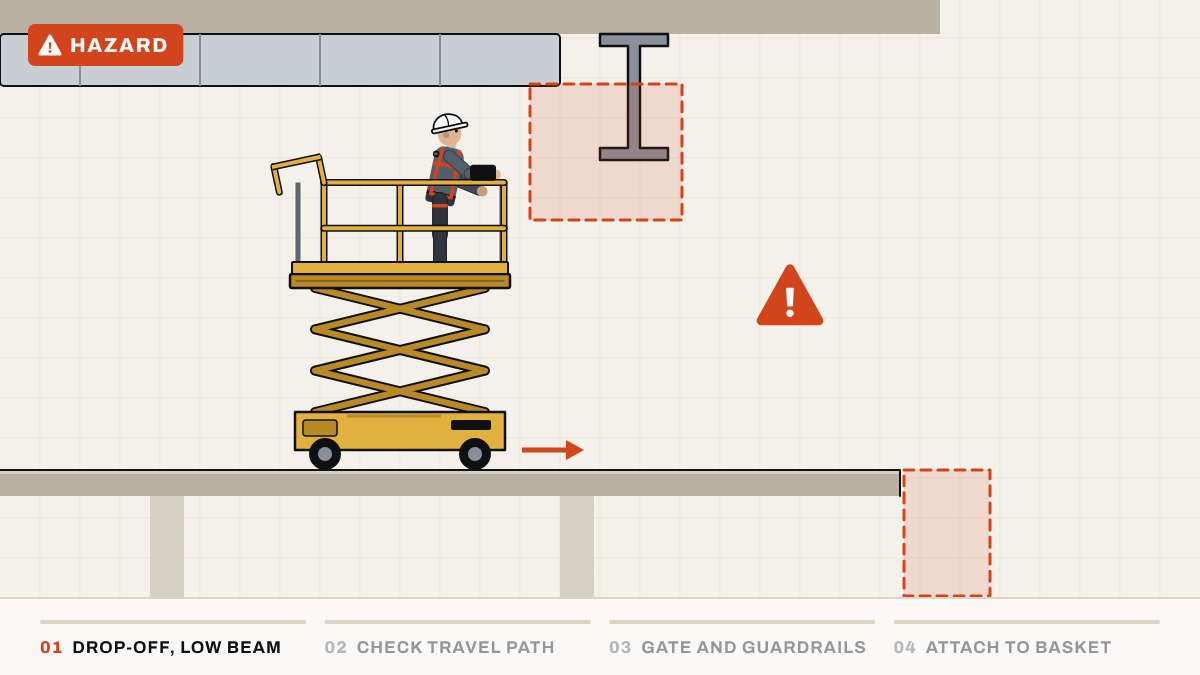
Where it shows up
- Boom lifts for steel connections and exterior work
- Scissor lifts for overhead MEP and drywall
- Driving a lift on a slab with openings or edges
Controls, most effective first
Work down the list. Rely on PPE only for the risk the controls above it cannot remove.
| Level | Control |
|---|---|
| Engineering | Keep the platform gate and guardrails closed and in place |
| Use lifts with secondary guarding or anti-entrapment devices near overhead structure | |
| Administrative | Pre-use inspection and function test each shift |
| Only trained and authorized operators | |
| Check the travel path for holes, drop-offs, slopes, and soft ground | |
| Follow the manufacturer wind and load limits | |
| Do not climb or stand on the guardrails | |
| PPE | Harness and lanyard attached to the boom or basket in boom-supported lifts |
| Tie-off in scissor lifts where the manufacturer requires it |
PPE to list on the JHA
Full-body harness and lanyard1926.502(d)Hard hat1926.100Safety-toe boots
OSHA standards
| Citation | Title |
|---|---|
| 29 CFR 1926.453 | Aerial lifts |
| 29 CFR 1926.452(w) | Mobile scaffolds |
| OSHA interpretation, Aug 1, 2000 | Scissor lifts are covered as mobile scaffolds |
Federal OSHA construction standards. State plans can be stricter, and owners or contracts can add requirements. This page is general information. Check the full standard for your work.