FallsOSHA Focus Four
Falls from height
Work at an unprotected side or edge 6 feet or more above a lower level. In construction, 29 CFR 1926.501(b)(1) requires guardrails, safety nets, or a personal fall arrest system at that height.
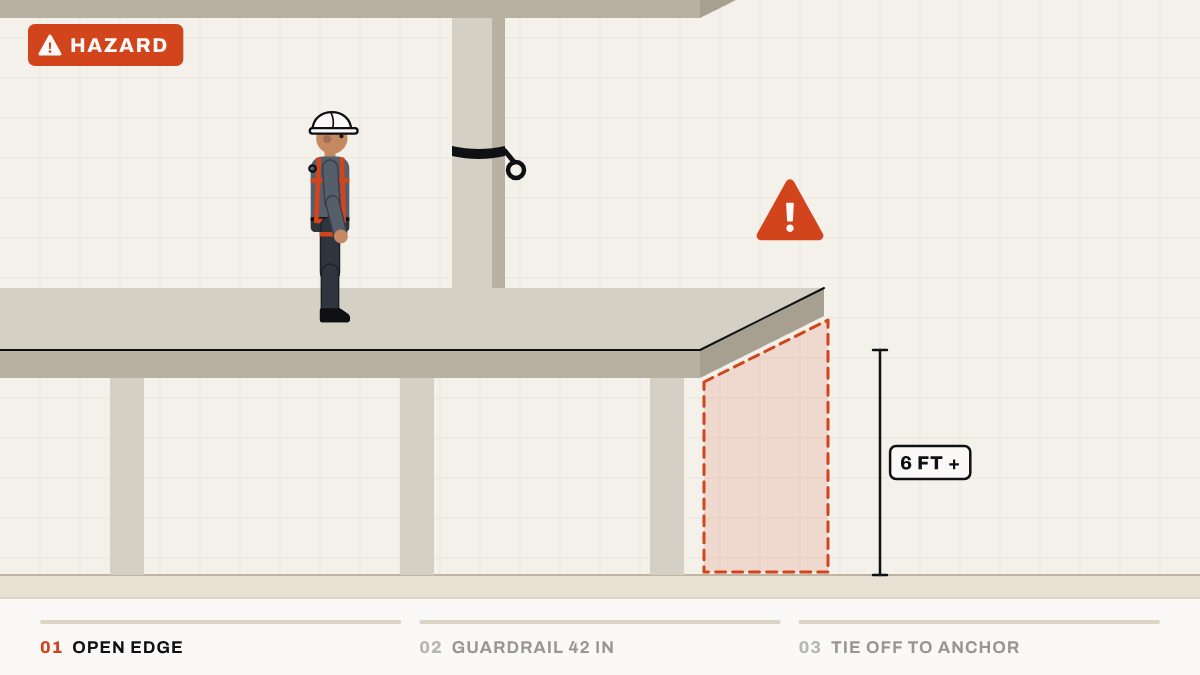
Where it shows up
- Leading edges on metal deck or formwork
- Roof edges and low-slope roofs
- Slab edges before perimeter protection goes up
- Elevator shafts and stair openings
- Climbing rebar walls or columns
Controls, most effective first
Work down the list. Rely on PPE only for the risk the controls above it cannot remove.
| Level | Control |
|---|---|
| Eliminate or substitute | Assemble components at ground level and lift them into place |
| Install permanent guardrails and stairs early in the schedule | |
| Engineering | Guardrail system with a top rail 42 inches, plus or minus 3 inches, above the walking surface |
| Safety nets as close as practical under the work surface | |
| Warning lines with a safety monitor on low-slope roofs where allowed | |
| Administrative | Written fall protection plan reviewed with the crew |
| Competent person inspects anchors and systems before use | |
| Rescue plan for anyone left suspended in a harness | |
| Fall protection training under 1926.503 | |
| PPE | Full-body harness and connector tied to an anchorage rated for 5,000 pounds per worker, or designed with a safety factor of two under a qualified person |
| Rig to limit free fall to 6 feet or less |
PPE to list on the JHA
Full-body harness and lanyard1926.502(d)Hard hat1926.100Safety-toe boots
OSHA standards
| Citation | Title |
|---|---|
| 29 CFR 1926.501 | Duty to have fall protection |
| 29 CFR 1926.502 | Fall protection systems criteria and practices |
| 29 CFR 1926.503 | Training requirements |
Federal OSHA construction standards. State plans can be stricter, and owners or contracts can add requirements. This page is general information. Check the full standard for your work.
Guides and toolbox talks
| Oct 5, 2026 | How to Write a Job Hazard Analysis (JHA): Step-by-Step Example |
| Sep 28, 2026 | Fall Protection Toolbox Talk: The 6-Foot Rule on Construction Sites |