Falls
Ladders
Falls from portable and fixed ladders, usually from overreaching, a ladder that slides out at the base, or standing on the top steps. Subpart X of 29 CFR 1926 covers ladder use in construction.
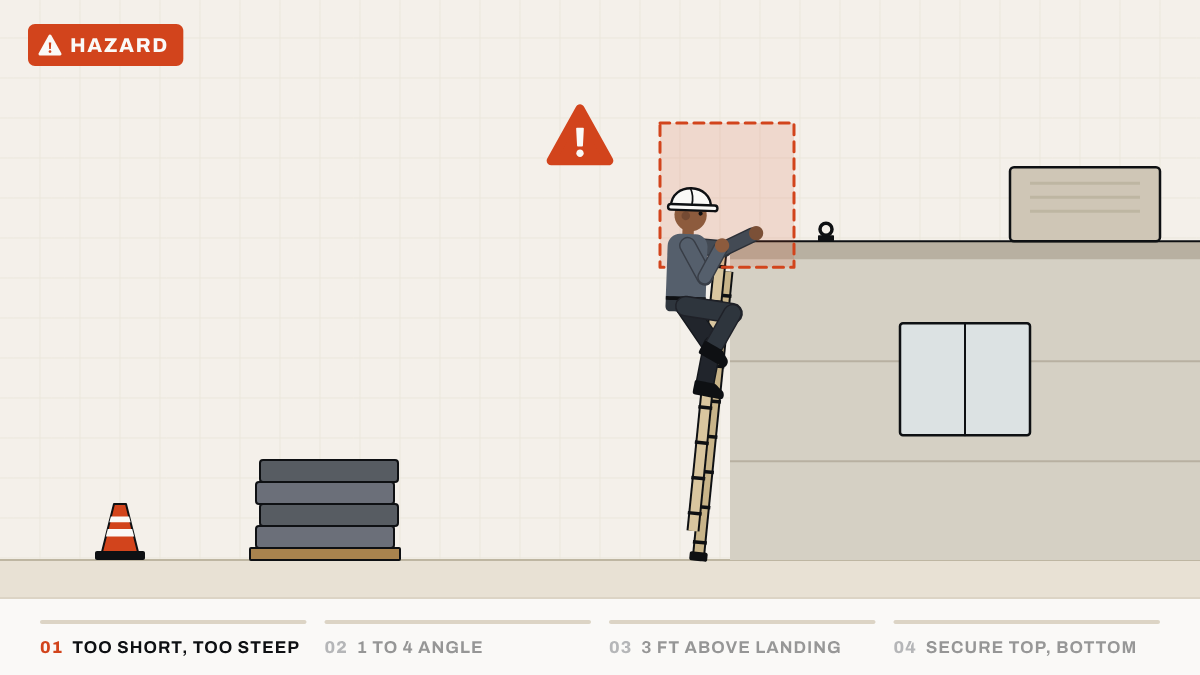
Where it shows up
- Stepladders used for overhead rough-in
- Extension ladders used to reach a roof or upper deck
- Job-built ladders
- Ladders set on uneven or slippery ground
Controls, most effective first
Work down the list. Rely on PPE only for the risk the controls above it cannot remove.
| Level | Control |
|---|---|
| Eliminate or substitute | Use a scissor lift, rolling scaffold, or platform ladder when the work lasts more than a few minutes |
| Engineering | Extend portable ladders at least 3 feet above the upper landing |
| Set non-self-supporting ladders at a 1 to 4 angle (base out about one quarter of the working length) | |
| Secure the top and bottom of extension ladders | |
| Use ladders with non-conductive side rails near energized equipment | |
| Administrative | Competent person inspects ladders, and defective ladders are tagged and removed |
| Do not stand on the top or top step of a stepladder | |
| Face the ladder and keep at least one hand on it while climbing | |
| Do not carry objects that could make you lose balance | |
| PPE | Slip-resistant footwear |
PPE to list on the JHA
Hard hat1926.100Safety-toe boots
OSHA standards
| Citation | Title |
|---|---|
| 29 CFR 1926.1051 | General requirements (stairways and ladders) |
| 29 CFR 1926.1053 | Ladders |
| 29 CFR 1926.1060 | Training requirements |
Federal OSHA construction standards. State plans can be stricter, and owners or contracts can add requirements. This page is general information. Check the full standard for your work.
Guides and toolbox talks
| Sep 28, 2026 | Fall Protection Toolbox Talk: The 6-Foot Rule on Construction Sites |